California, for good
2011.08.15 in personal
California
For the first time in my life, there's no clear "next step", and, finally, really no need for one, either. In June I moved across the country, all the way from Vermont to Cupertino, California, following the call of the most amazing job offer I could have imagined.
I spent the summer of 2010 in San Diego, so I'm at least somewhat acquainted with living in California; the Bay Area seems to be a little quieter, but I'm all for that! Plus, it puts me smack dab in the middle of what is quite literally the epicenter of the software world; the PARC and Stanford are to the west, with hundreds of startups dotted along in that direction, stretching all the way to San Francisco; Google is only a few miles north; Apple is less than a block east; and the home of pretty much every American tech company that matters is within biking distance.
Home
I decided quite quickly that it would be best to live as close to campus as possible, as I don't enjoy driving, don't have a car, and hate depending on public transit to get to work (it's fine if you're not on a schedule, like weekend trips, but not for getting to work). When I called to see what was available, there weren't many options; of the four apartment complexed I called, only one had any space, and even they only had two units available at the time.
Luckily, I managed to acquire one of those, and now call home the corner of Homestead and Stelling, right on the border between Cupertino and Sunnyvale, along with five hundred other people! It's a simple apartment, more than big enough for one person (it easily fit two when Matt was here, and we're going to get to see how well it fits four this week when my family comes out!).
I guess I'll take you on a brief tour of what I've done with the place:
It's got a couch, which Peter and I built the first day I moved in, and I've slept on way more than once; a back porch, with some chairs that let me hang out outside occasionally, and a few plants that mom put there when she was out, some of which have died, and some of which have lived happily.
This one is my favorite, because it's the least dead and seems to be the easiest to take care of, and because it doesn't shed purple stuff all over everything like one of the others does.
I have a projector, which projects a 100+ inch image on the wall for when I want to watch Doctor Who or Game of Thrones, or random movies with Peter/Alex/James/Charles/etc. (all of whom are leaving me in the next few weeks to go back to school). Plus the requisite receiver and speakers, with wires running all over the house. And I can stream video and audio to it from any of my Apple devices, wirelessly. Pretty awesome. The convenient thing about a projector is that it gets almost completely out of the way when you aren't using it.
And my extra iPhone as a remote (which is pretty awesome; one remote, just the few buttons I actually need, customized exactly how I want it — no mode switches or other crap like everyone (especially at Vivian's or at home) is used to, and there's a keyboard for the Apple TV if I want to search for something!)

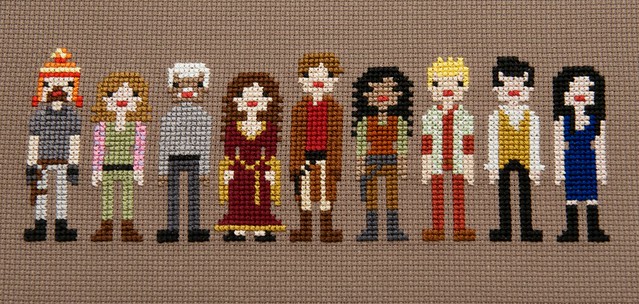
After a rather harrowing experience driving home from IKEA with it, I also have the requisite computer desk, new home to Jayne and Trinity, and with plenty of space for paper and laptops and tablets galore. And speakers, attached to a legit soundboard, which merges the audio from 1) a cable to plug into random devices 2) Jayne and 3) an AirPort Express, so I can play music from anywhere to it and not have to worry about going under my desk to move the cable around like I had to in Troy. A bit overkill, but it works with no fuss.
Grandma's table and chairs sit in my dining room, which is not so much a dining room as it is an extension of my living room. I don't have many opportunities to use the table as anything but storage; I usually eat at my desk or on the porch.
When I was packing, I found the printed pictures from my closet door in Davison, so I carefully packed them away and put them on my bedroom door here, along with some bits of DJ's pen art. I've also got a little spot on the wall in my room with pictures of past homes; Colchester, Cary, our apartment on 15th St., and the complex in La Jolla. I'll add Hurley if someone finds me a picture.
I've got a second desk in my bedroom, adorned with random electronics, a soldering iron and power supply, and various related things. I haven't had an opportunity to do much here, but as I don't generally feel like working on software when I get home (except on the weekends!), I expect that to become a more common hobby.
The little dresser in my room was also by far the hardest piece of furniture to build. To anyone who complains about IKEA construction: you don't know what you're talking about. Chair, living-room desk, tables, couch — all IKEA, all relatively straightforward. That dresser, though, ... I got it from some random company on Amazon, and I swear I had holes in my hands by the time I was done constructing it, and I'm still surprised it hasn't fallen apart. But, it does its job.
My bike sits just out my back porch, near the mailboxes. Sometimes I take it to work, or to the bank, or to the bay, or wherever.
Every time I leave my house and venture into the apartment complex instead of immediately out to the main road, I get quite lost; I'm getting better at it, but I've been here long enough that I think there must be something wrong with their design (there is! the uniformity!).
Work
Work is fantastic. I noted before that I won't talk much about it here, but I can at least say that I have the best team I can imagine and that I love it here! A whole variety of different things have happened over the past two months that solidify my belief that this is exactly where I want to be.
I think it's going to be really bizarre at the end of August when I'm still doing the same thing, at the same desk, instead of returning to dear old RPI, but I'm quite convinced it's going to be a good bizarre.
I've made friends with a bunch of interns through Peter, but these are their last weeks; in just a few days, there'll be none left, and I'll have to make more friends! (as well as wait and see who comes back!) It's easier to get to know the interns, since we were all new at the same time; I wonder if starting work outside of intern season would have made it more straightforward in the first place.
The Bay
Despite being here for two months, I haven't done much exploring of the bay yet. A day trip to the South Bay, a day trip to Saratoga, a few into San Francisco and San Jose. I don't feel the urgency to get out every day of every weekend like I did in San Diego (to be fair, I'd be packing up to leave in another week or two, were it last summer again), which is leading to a more relaxing time, for sure!
Places I've been entertained by so far include the San Jose Repertory Theatre (to which I'm certain I'll be returning), the island in the middle of Stow Lake, Sammy's on Second (a little sketchy at first, but delicious, and then you can walk to the gardens and eat your sandwich), both the Computer History Museum and the Tech Museum (though the latter seemed like a distant shadow of the Boston Museum of Science), some cute little park just off the main road in Saratoga, a variety of different modes of public transit (compared to Boston, they're mad here, with a zillion separate companies running a zillion different services; the subways aren't run by the bus people aren't run by the light rail people, it's all crazy), a mysteriously missing trail by the Steven's Creek Reservoir, the Steven's Creek Bike Trail itself (gotta visit Google and the Bay!), and a wide variety of little places in and around the city of Cupertino.
Eventually some of these will get their own stories, but for now they sit as a simple list.
I'll probably be making a map in the near future, to add to and use to remember things, and I'm sure I'll post it here.
Back to work tomorrow!